Life-Changing…

Extract from Gaur Gopal’ Book: ’Life’s Amazing Secrets’

https://archive.org/details/lifes-amazing-secrets-how-to-find-balance-and-purpose-in-your-life_202112

To most people, the word ashram induces a romanticized vision of a temple situated in the foothills of a mountain whose name is difficult to pronounce. But not our ashram! Our ashram is a network of corridors in South Mumbai, a part of town that never sleeps. With over 100 monks living together, it can feel congested at times. One can imagine how long we’re waiting for the bathrooms in the morning.

One day, ten years ago, I stormed into the room of my spiritual guide, Radhanath Swami. We’re fortunate that he lives with us in the ashram, giving us easy access to him to share our joys and listen to our grievances. Have you been inside his quarters? They’re extraordinary! If you could capture the smell of simplicity and sell it as a fragrance, it would be the essence of his room. Measuring a mere 5 sq. metres, with two simple tube lights and straw mats that line the floor, it feels as if one is entering a village home. The place is barren of furniture except for a small table that rests a few inches above the ground and a wooden chair for the elderly guests who visit him. Bookshelves line two of the walls up to the ceiling, with ancient books of wisdom sitting side-by-side with contemporary research. Musical instruments—a harmonium, and a mridangam drum—sit next to the focal point of the room, a small altar on which rest the deities of his meditation.

‘It’s all changing,’ I whispered under my breath as I knocked on my guru’s door.

‘Come in!’ he said. I sulked through the wooden doors with my head down.

Radhanath Swami was sitting on the floor at his modest desk, his legs crossed and back straight. I repeated what I had said a little louder as I sat down and crossed my legs.

‘Tt’s all changing!’ I couldn’t take it; I had to tell him.

‘Gaur Gopal?’ he said inquisitively in his American accent that now had hints of an Indian one. He peered at me over his reading glasses with a penetrating gaze. He closed the book he was reading, which had a cover that looked like a relic from a bygone era, and went back to his original stance with his hands in his lap. I had his attention. That was my signal to speak.

I exploded. For forty-five minutes I nitpicked every grievance I had with the management of the temple and the many people who had wronged me. I complained that if this continued, it would ruin our community. I felt like a self-appointed saviour who had to point out these negative mannerisms creeping into our society. ‘If we do nothing about all this, everything will be spoiled,’ I finally ended. He sat there with a grave look on his face. Not a word left his mouth as I grumbled on.

‘Have you finished?’ he said sternly.

I sighed, ‘Yes.’

‘There are so many positive things happening in our community,’ he started.

For the next forty-five minutes, he did not mention a single complaint I had made. He only focused on the positives, uplifting my mood. ‘I am not saying these problems don’t exist, but the real problem is that when negativity consumes the mind, not only do we lose the vision to see the beautiful things around us, but also the ability to solve the problems that confront us. We have to train our mind to focus on the positive and feel empowered to deal with the negative.’

He then spent equal amounts of time going through the practical solutions to all my problems and then swiftly instructed me to go for lunch with all the other monks in the dining hall. He did not ignore the fact that some of my complaints were genuine. It was not that the problems I had were not real. We all go through real challenges, for which solutions should be found. But what Radhanath Swami taught me was the power of having a positive state of mind whilst dealing with problems constructively.

‘That brings a lot of clarity,’ Harry said.

I could sense a ‘but’.

‘But how long did your positive attitude last? Are you telling me that

Radhanath Swami just told you to be positive and it miraculously happened?’

“Well the miracle lasted at least an hour until lunchtime,’ I laughed. ‘This state of mind develops over time, and I realized that fully while eating lunch.’

I left Radhanath Swami’s room in high spirits. That’s one of the effects of enlightened people; they make others feel inspired in their company. I galloped to the lunch hall (not physically; anyone who has ever worn a dhoti would understand how hard that is) elated and full of positive energy. The kitchen at our ashram cooks lunch for over 200 people daily. They have pots bigger than some grown men, and gas burners with flames larger than many ceremonial wedding fires. National Geographic featured our kitchen in their documentary on India’s Mega Kitchens.

Steamed rice, dal (lentil), spicy vegetable curries and hot flatbread chapattis— a simple, but satisfying lunch. What enhanced the flavour for me even more was the new appreciation for the people around me. The people in the room were a bit like my lunch. On occasions, the dal does not have enough salt, the curry is too spicy, or the gulab jamun has a bit too much ghee. However, they still nourish me. I looked at every face in that hall. I may have perceived faults in them in the past, but they had all helped me in my journey. I learnt on that day that when we think negatively of people, we should immediately counteract that energy by contemplating three positive qualities they have. I did make some awkward lingering eye contact with many of the monks in that hall as I gawked at them, leaving them with confused expressions. But my intention was correct; I was training the mind to see the good. Not for winning arguments!

*******

A Wrong paid off with a Right?

It happened some months ago.

It was in our rented flat. Suddenly we discovered shelves/drawers being gnawed away.

Must be the open windows and the box grill. That we were on second floor was no deterrent.

Attempts to trap the fellow – did not know it was a she-fellow then😊 – failed.

It was not a comfortable feeling that we shared residence with a rodent with a free run.

What was he up to at this moment?

One day, early in the morning – about five-ish, still dark outside – I was pottering about, getting things together for preparing coffee.

That’s when my bare toe touched something squishy. Turned on more lights for a closer look.

Omg! It was a pup, a baby rat. A bundle, alive, helpless. Newborn? Had never seen one before.

So, she was rearing a family under the same roof!

I panicked. How many more? They didn’t come in ones or twos. Visions of the apocryphal piper leaped before me!

Without a thought, donned a plastic bag as a glove, picked him up, slid the window open and dropped the little thing down.

Looked around for more, found none.

**

Regained my wits only to be awash with guilt – should I have handled it differently? Little chance the pup survived the fall. If it did, it would still make an easy meal for a cruel crow. Should I have gone down and dropped it gently on the ground amidst the thick bushes down there?

The guilt stayed with me, suppressed for now, but bobbing up from time to time. Never gone away.

**

This morning, I was on my third round of the garden. Walking slowly, planting firm steps on tiles paving the track, green with patches of moss here and there. Very slippery.

Suddenly I heard something whoosh by to my left. Startled, stopped in my stride.

It was an eagle, normally not sighted flying so low.

For some strange reason – maybe he too was startled at my presence – something fell from his beak. And without a pause he flew away, unmindful of the loss.

There it lay on its back, a dazed baby rat!! One moment sailing in the air, and the next, thud on the ground! Struggling to get back on feet.

I rushed to its side, without a thought of ‘what next?’.

I was not the only one to spot the poor little thing.

A crow perched on a low branch swooped down menacingly.

Kept him away, flailing my arms about.

Meanwhile, the baby was floundering hither and thither trying to get away.

What should I do? Can’t stand on guard for long. Can’t pick it up and put it in my bag.

It was a rerun of the scene I had found myself in on that occasion.

Luckily for me and for the baby, there was a drain-hole nearby, within a couple of feet, for the rain-water to be carried away.

I nudged the fellow slowly but firmly towards the mouth of the drain.

To my great relief, soon the current took him along swiftly; in a few moments, he disappeared into the mouth of the drain. Sure to live for another day?

**

Was that reparation enough? Had I redeemed myself? Were the accounts balanced in the books?

There lurks a fear Karma looks at it differently. Mmmmm…

End

Unknown Guru

On this auspicious occasion of Guru Purnima:

Biggest regret: never thanked teachers in school and college🤫 Parents…tho, dhoor ki baath (far out)!

When I do parikrama (rounds of the sanctum) in the morning at the temple, I look at a basket where flowers are discarded by the priests. Usually I pick up a few good ones – many times, perfectly good stuff is discarded due to the problem of plenty – to be used to adorn dieties in the mini-shrine at home. Only the good ones. 

Today, my eyes glowed, sighting a thick garland of brilliant green tulsi (basil), looking very fresh.

Ah…lucky…I planned to pick it up on my last round of the sanctum.

Oh…a lady, interloper – had not seen her before – got ahead of me. She was pausing…peering at the basket. 

My heart skipped a beat.

I shd have picked it up when I saw it first:-(

And, there I saw her picking up the garland. 

My heart sunk further. I froze in my stride.

But what is this? 

She took a small knife from the platform, kept for use by the priests to open packets of haldi, kumkum, sandal powder…offered by devotees. Snipped a piece off the garland which she carefully returned to the basket!!!

Why wld she do that?

Went up to her and asked. At my age and looks, they don’t get offended. 

“So, others too can have a piece!”

Ah!!!

Guru’s, appear at places at times, often unknown and unsolicited!!!

End

A Giant Knows…

After dinner, the children turned to Jacob and asked if he would tell them a story.

“A story about what?” asked Jacob.

“About a giant,” squealed the children.

Jacob smiled, leaned against the warm stones at the side of the fireplace, and his voice turned softly inward.

“Once there was a boy who asked his father to take him to see the great parade that passed through the village. The father, remembering the parade from when he was a boy, quickly agreed, and the next morning the boy and his father set out together.

“As they approached the parade route, people started to push in from all sides, and the crowd grew thick. When the people along the way became almost a wall; the father lifted his son and placed him on his shoulders.

“Soon the parade began and as it passed, the boy kept telling his father how wonderful it was and how spectacular were the colors and images. The boy, in fact, grew so prideful of what he saw that he mocked those who saw less saying, even to his father, ‘If only you could see what I see.'”

“But,” said Jacob staring straight in the faces of the children, “what the boy did not look at was why he could see. What the boy forgot was that once his father, too, could see.”

Then as if he had finished the story, Jacob stopped speaking.

“Is that it?” said a disappointed girl. “We thought you were going to tell us a story about a giant.”

“But I did,” said Jacob. “I told you a story about a boy who could have been a giant.”

“How?” squealed the children.

“A giant,” said Jacob, “is anyone who remembers we are all sitting on someone else’s shoulders.”

“And what does it make us if we don’t remember?” asked the boy.

“A burden,” answered Jacob.

>>> 

From: funnies-owner@lists.mikeysfunnies.com

End

Words To Chew On

From FS (Farnam Street) Briain Food vide FS (a free blog) for “actionable ideas and insights you can use at work and home”.

“Don’t aim at success — the more you aim at it and make it a target, the more you are going to miss it. For success, like happiness, cannot be pursued; it must ensue, and it only does so as the unintended side-effect of one’s dedication…In the long run — in the long run, I say! — success will follow you precisely because you had forgotten to think about it.”

— Viktor Frankl

“The common trait of people who supposedly have vision is that they spend a lot of time reading and gathering information, and then they synthesize it until they come up with an idea.”

— Fred Smith, Overnight Success: Federal Express and Frederick Smith, Its Renegade Creator

“People are more adept [at] working against [things] than oftentimes we give them credit for. We often think of people working for things, but they often work against things. They work against poverty. They work against their upbringing. They work against some of these things just as much as they’re working for them. Some people are very fear-driven. We talk about fear as being very negative, but it also can be very positive.”

— Dr. Julie Gurner

You don’t need more time; you need more focus. Fewer projects. Fewer commitments. Fewer obligations. Fewer responsibilities. Carefully choose your commitments, then go all in.

Rich people have money. Wealthy people have time.

In the short term, you are as good as your intensity. In the long term, you are only as good as your consistency.

End

No Roads Take To A Destination…

which is there now and not there next.

From Emily Esfahani Smith (journalist/author of “The Power of Meaning”) in her Ted talk:   

I used to think the whole purpose of life was pursuing happiness. Everyone said the path to happiness was success, so I searched for that ideal job, that perfect boyfriend, that beautiful apartment. But instead of ever feeling fulfilled, I felt anxious and adrift. And I wasn’t alone; my friends — they struggled with this, too…

Eventually, I decided to go to graduate school for positive psychology to learn what truly makes people happy. But what I discovered there changed my life. The data showed that chasing happiness can make people unhappy. And what really struck me was this: the suicide rate has been rising around the world, and it recently reached a 30-year high in America. Even though life is getting objectively better by nearly every conceivable standard, more people feel hopeless, depressed and alone. There’s an emptiness gnawing away at people, and you don’t have to be clinically depressed to feel it. Sooner or later, I think we all wonder: Is this all there is? And according to the research, what predicts this despair is not a lack of happiness. It’s a lack of something else, a lack of having meaning in life…

But that raised some questions for me. Is there more to life than being happy? And what’s the difference between being happy and having meaning in life? Many psychologists define happiness as a state of comfort and ease, feeling good in the moment. Meaning, though, is deeper. The renowned psychologist Martin Seligman says meaning comes from belonging to and serving something beyond yourself and from developing the best within you. Our culture is obsessed with happiness, but I came to see that seeking meaning is the more fulfilling path. And the studies show that people who have meaning in life, they’re more resilient, they do better in school and at work, and they even live longer…

So this all made me wonder: How can we each live more meaningfully? To find out, I spent five years interviewing hundreds of people and reading through thousands of pages of psychology, neuroscience and philosophy. Bringing it all together, I found that there are what I call four pillars of a meaningful life. And we can each create lives of meaning by building some or all of these pillars in our lives…

They are:

The first: “The first pillar is belonging. Belonging comes from being in relationships where you’re valued for who you are intrinsically and where you value others as well…”

The second: “For many people, belonging is the most essential source of meaning, those bonds to family and friends. For others, the key to meaning is the second pillar: purpose. Now, finding your purpose is not the same thing as finding that job that makes you happy. Purpose is less about what you want than about what you give…”

The third: “The third pillar of meaning is also about stepping beyond yourself, but in a completely different way: transcendence. Transcendent states are those rare moments when you’re lifted above the hustle and bustle of daily life, your sense of self fades away, and you feel connected to a higher reality. For one person I talked to, transcendence came from seeing art. For another person, it was at church. For me, I’m a writer, and it happens through writing…”

The fourth: “The fourth pillar is storytelling, the story you tell yourself about yourself. Creating a narrative from the events of your life brings clarity. It helps you understand how you became you. But we don’t always realize that we’re the authors of our stories and can change the way we’re telling them. Your life isn’t just a list of events. You can edit, interpret and retell your story, even as you’re constrained by the facts…”

Well, there it is.

Of the four, the last, storytelling would not resonate with most of us in this land. It’s similar to the view that holding an image of yourself standing on the victory stand gets you there, or helps. Here it is considered as completely self-delusional, not seen as of value.

Among the other three, sense of belonging and transcendence could provide helpful support for carrying on, the main is the ‘purpose’, the key.

At the station many of us are in life, constrained physically, mentally and financially, even little acts/words of kindness to relieve, even if momentarily, other man’s (sentient or otherwise) burden, is a good enough purpose to pursue. Would want us to long and live for another day in life! What do you think?

A recent article on the subject in TIME kind of confirms the need for a higher purpose. It says researchers have found the long-touted strategies for Happiness –

‘- do not provide sustained results.!!!

Well, what does at all then?

Not surprising at all if it is understood happiness is a transitory state of mind while purpose is a soul-satisfying driving force.

The Ted talk is available here: Emily Esfahani Smith: There’s more to life than being happy | TED Talk and the article in Time at: Science Studies Don’t Actually Support Happiness Strategies | Time

End

Living Is Life!

Rashmi Kothari in Quora

(lightly edited)

**

Some people just come in your life to inspire.

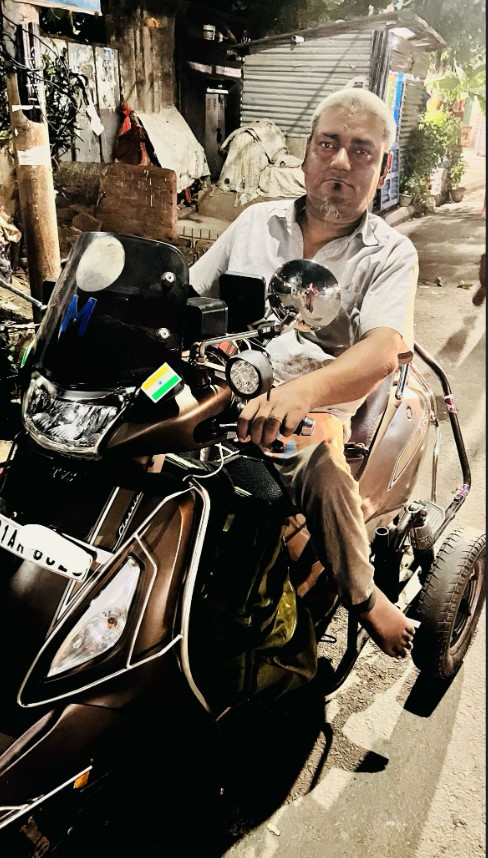
One such incident happened with me yesterday. I had booked an Ola Bike (like taxi) and the vehicle that arrived surprised me. It had two extra wheels at the back.

I gave him the OTP (onetime password like “It will rain in May!!”) and asked for a helmet (didnt know it is included in the ride!). The driver said it was an army bike, and I didn’t have to put a helmet. I insisted because what if the traffic police would fine me and also was it safe? He said, “Arey Madam ji aap chinta matt karo ye especially abled Ex-Army Man ki scooty hai koi kuch nahi bol sakta aur isme 4 chakke isiliye hai taaki aap safe raho” (please ma’am be rest assured nothing would happen since it’s an Ex-Army Man’s scooty also it has 4 wheels so that it doesn’t slip).

He had a speaker attached on the bike and was vibing on Ed Sheeran’s ‘Beautiful People’ and ‘I am so Lonely’ by Arash. Trust me his playlist, at the age of about 50 was much better than 80% people our generation.

The entire ride I had so many questions going on in my mind. After the ride ended, I asked him his name and that even after lower body completely paralysed why does he have to ride an Ola Bike? If he said this was an army bike, doesn’t he get a pension from the Government?

His replies made me…

Meet Mohan Khan (name changed for confidential purposes). That name makes you curious right? Well, his mom was from a Hindu Brahmin family and his father was a Muslim. He had served in the army from 1993-2004. Due to a mishap, he survived but his lower body was paralyzed forever. He does get a pension but rides a bike for fun because he feels lonely at home. He never married because of the accident. He likes listening to English songs and riding this customised scooty that he got himself from his pension.

He rides a scooty even after being differently abled.

He sings out songs loud.

He is happy with whatever he is doing.

He wishes to live!

Jai Bharat (Hail India). That’s what he said to me when I turned back to go home. I replied with a Jai Bharat too!

**

End